WITHOUT
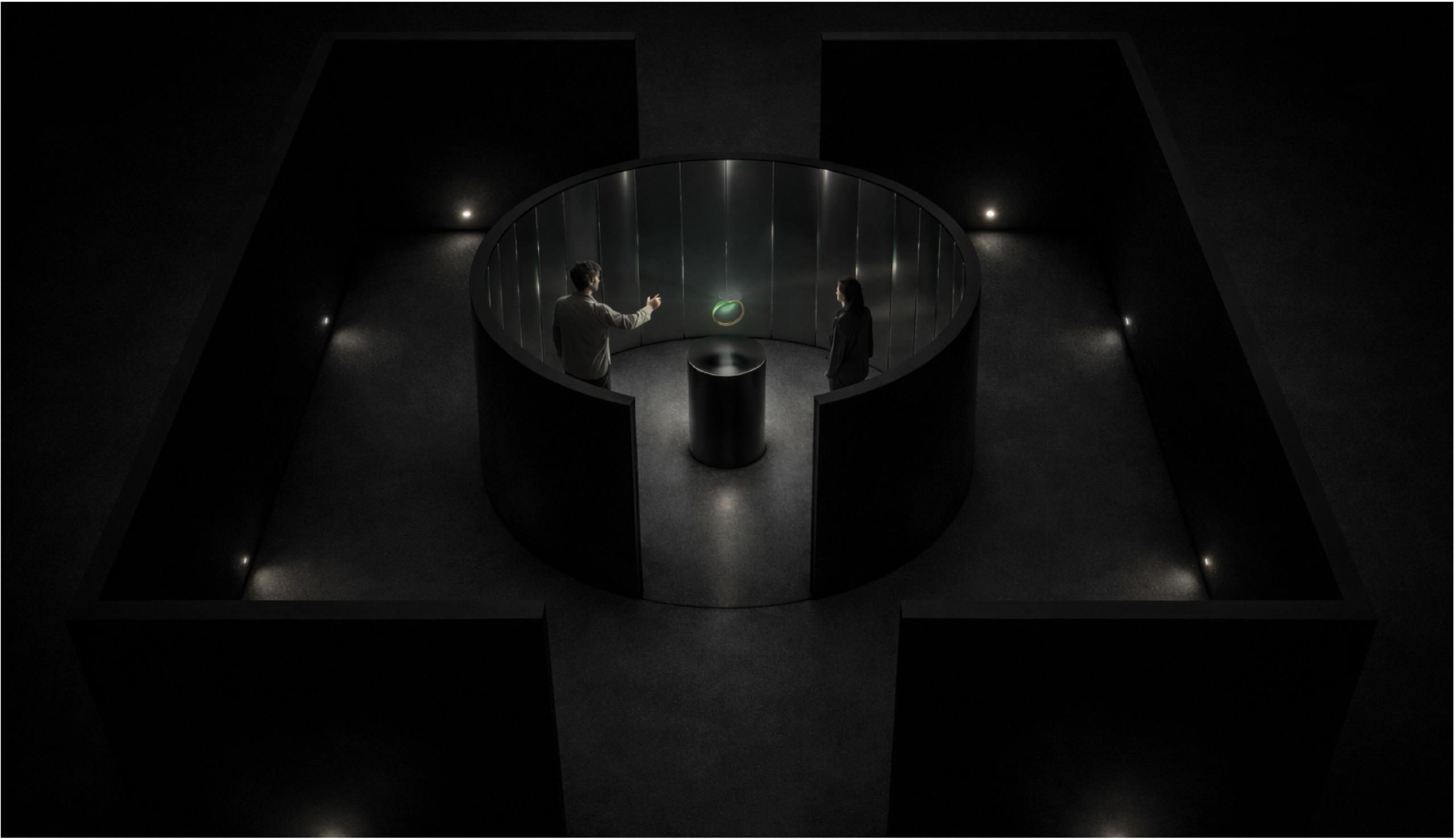
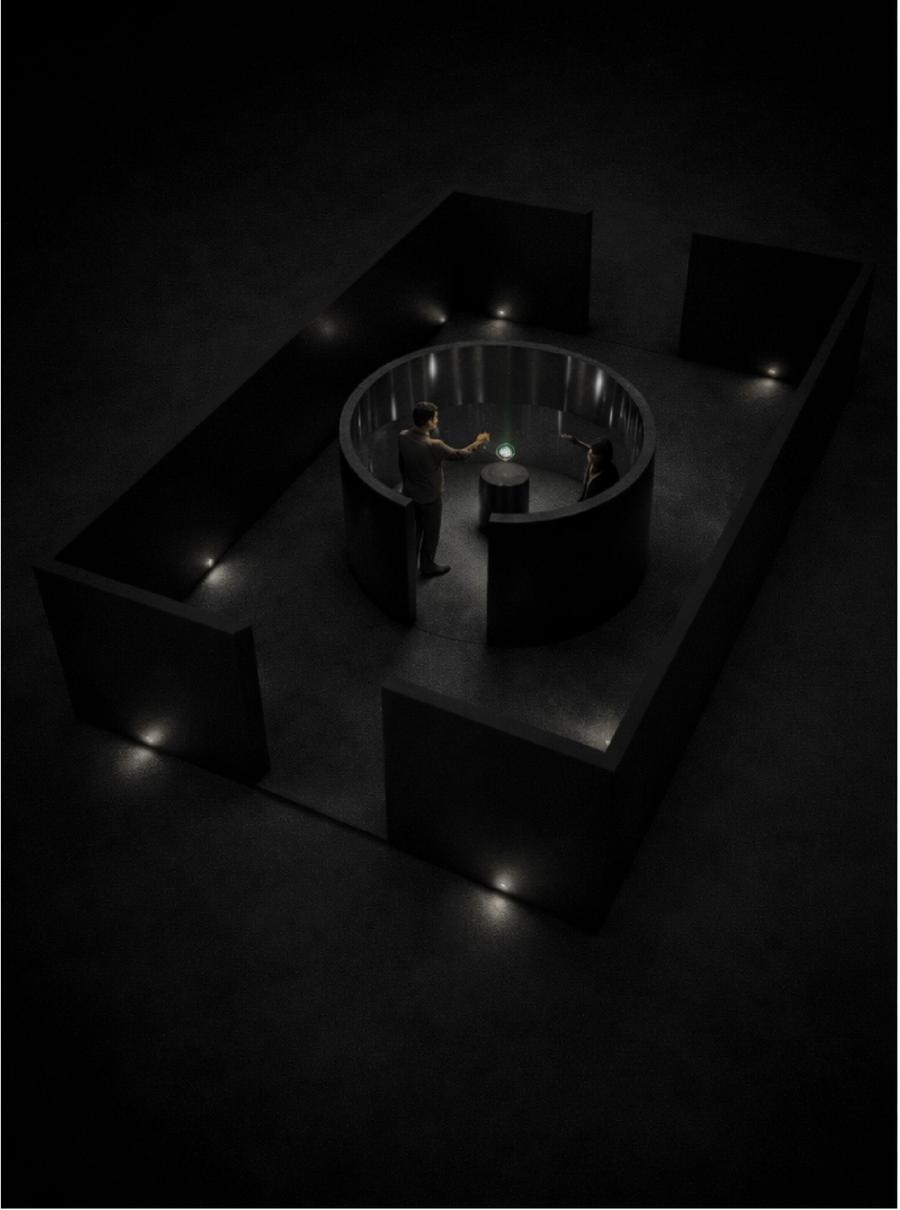
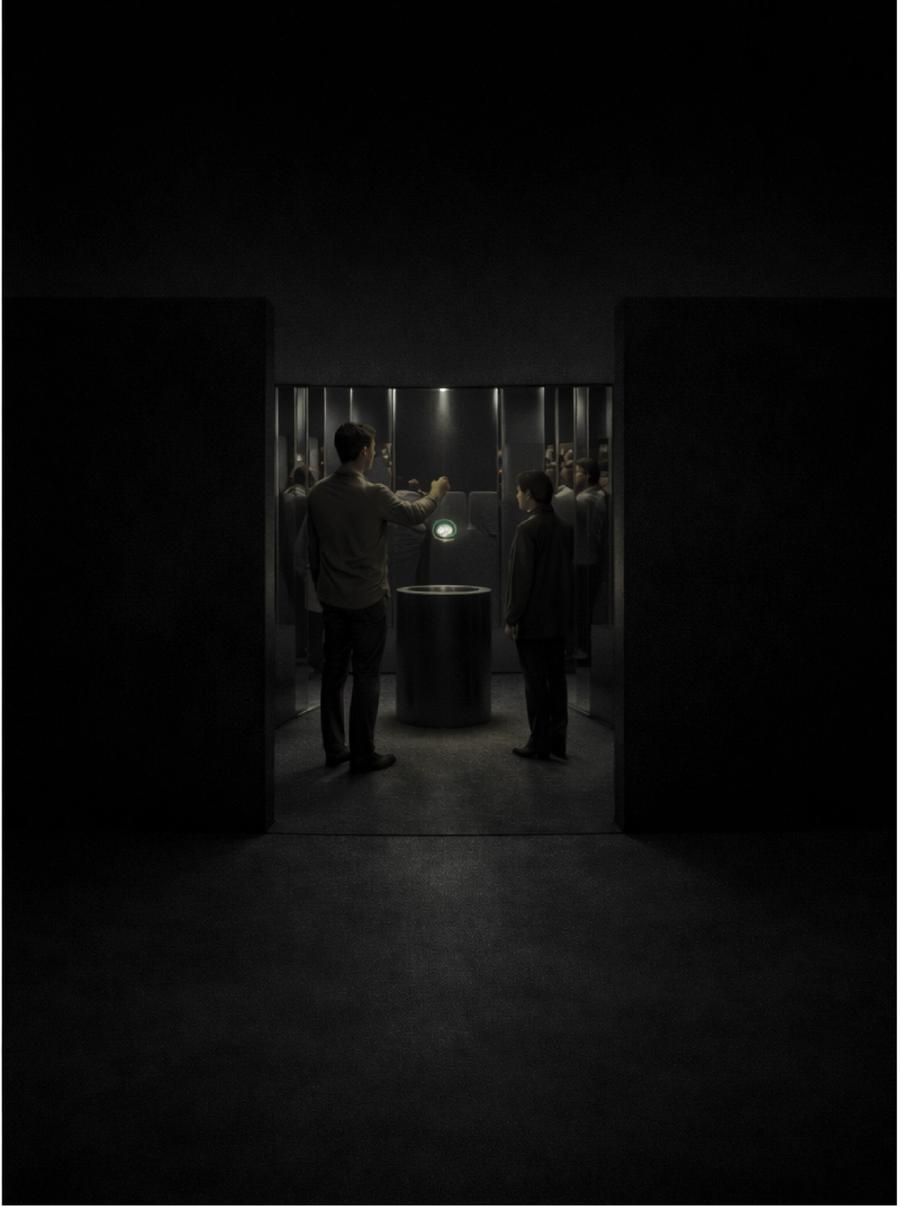
WITHOUT occupies a cylindrical room — a psilo — with an inner radius of 1800mm and a ceiling height of 4200mm. The walls are lined floor-to-ceiling with mirrors on the inner face. There are no corners. There is no visible edge. The visitor enters through a single 800mm arched opening and finds themselves inside a space that has no end they can see.
The choice of a cylinder is not aesthetic. It is structural to the argument. A rectangular room has corners — fixed points, orientations, a sense of what is behind you and what is ahead. A cylinder removes all of that. Every direction is equally valid. Every position is equally far from the wall. The visitor has no spatial anchor except the ring. The mirrors compound this — they reflect the visitor and the ring simultaneously, receding in both directions to what appears to be infinity. The visitor cannot see where the space ends. They are surrounded by versions of themselves, all walking around the same ring, all reaching at slightly different moments. The psilo makes superstition feel like the shared condition it actually is: not one person’s private embarrassment, but an infinite multiplication of the same human gesture.
The room operates in near-total darkness. The ambient light level does not exceed 30 lux. The projector that generates the hologram is the sole light source in the space. When the holographic ring is the only source of light in a mirrored cylinder, it becomes the organising principle of the entire space. Every surface catches it. The reflections multiply it. The visitor moves toward it not because they have been directed to, but because there is nowhere else to look.
The psilo
The ring is a specific ring. It is the artist’s own emerald ring, worn daily on the right pinky finger, acquired on instruction from an astrologer in Delhi. The instruction: wear it for luck and for life. The anxiety when it is missing is the subscription fee.
The holographic projection is a reproduction of this specific ring at life size, produced using a Pepper’s Ghost illusion — the same optical principle used in theatrical ghost effects since the nineteenth century. A projector beneath a reflective angled glass panel creates an image that appears to float in the air at approximately 1200mm above floor level — the exact height of an outstretched hand. Not too high to reach. Not too low. Reachable. Deliberately, precisely reachable.
The ring rotates at a constant slow speed — one full rotation every four seconds. The belief is never perfectly still either. The maintenance of superstition is ongoing, daily, never finished. The rotating hologram performs that restlessness.
The hand closes on light. The projection continues.
The choice of a hologram over a physical object is the most important decision in the installation. A physical ring could not be reached through. A physical ring, touched, would be confirmed. The anxiety would be resolved. The hologram refuses this. The hand closes on light. The projection continues. The ring remains, undisturbed, exactly as it was before the reach — which is also how the ring behaves in the daily practice of superstition. The belief persists even after the hand passes through. The ring does not know you grabbed for it. The anxiety is entirely yours.
A hand sensor detects when a visitor’s hand enters the field of the hologram. At that moment — at the moment of the reach — a very quiet sound plays. Not a failure sound. Not an alarm. Something between a breath and a tone: the sound of something almost there. After approximately three seconds the sound fades. The ring continues to rotate. Silence returns. The installation does not punish the reach. It simply marks it. And then returns to its prior state, as if the reach never happened — as if the hand never tried. This indifference is structural. The ring is indifferent to whether you believe in it. The luck it is supposed to carry does not register your attempt to take it. WITHOUT makes that indifference physical: the ring glows on regardless, completely unaffected by the human hand that passed through it.
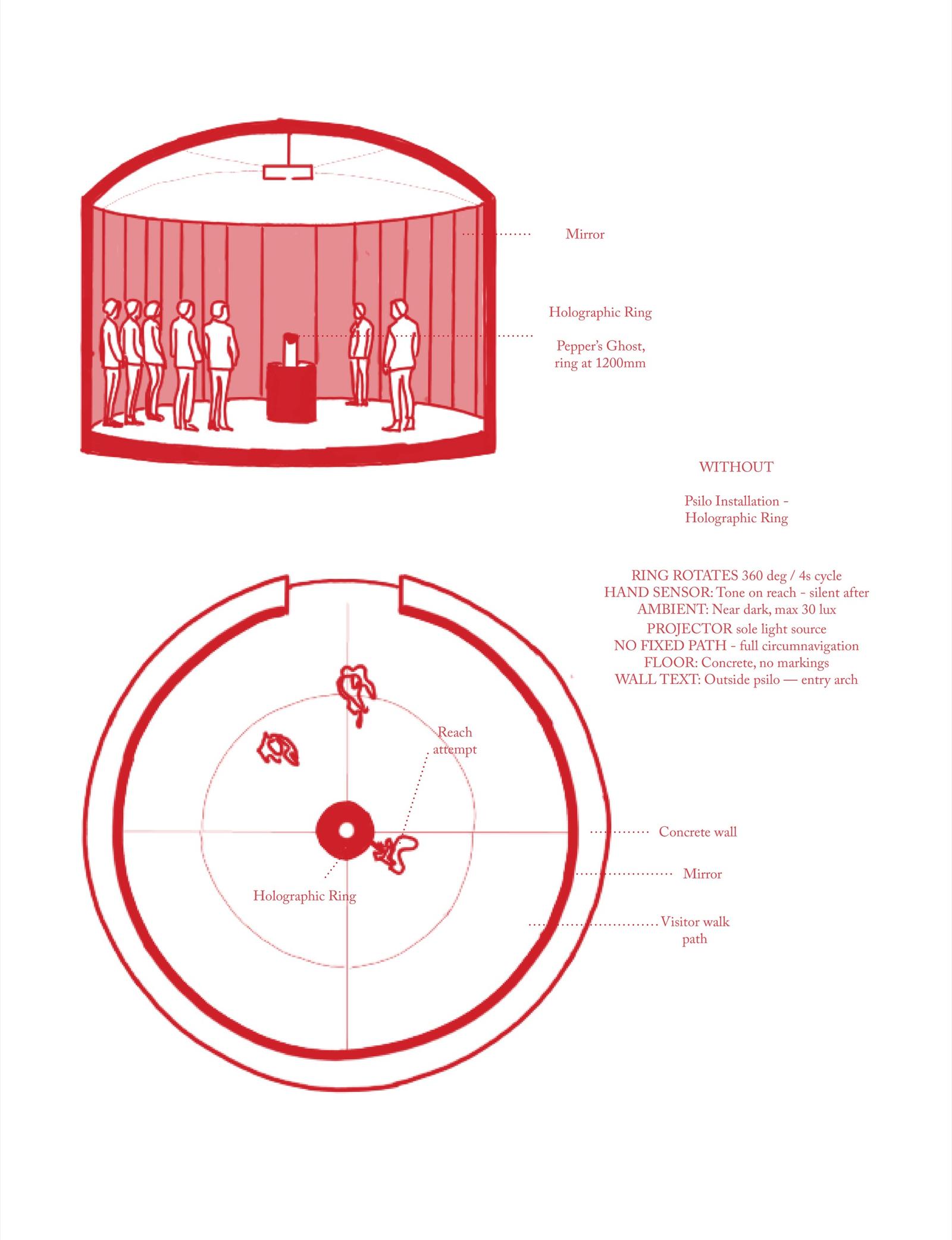
Her drawing sheet, whole: WITHOUT — Psilo Installation, Holographic Ring. Ring rotates 360° on a 4-second cycle · hand sensor tones on reach, silent after · near dark, max 30 lux · projector the sole light source · no fixed path, full circumnavigation.
WITHOUT engages most directly with three of the six emotional categories from Ch 3.
Luck — the ring was acquired for luck. The astrologer prescribed it. The visitor encounters a ring that is visually and spatially perfect and cannot take it. They cannot claim the luck it represents. The installation denies access to the very thing the superstition promises.
Anxiety — the wall text positions the ring as the object of daily anxiety. The hologram makes that anxiety structural: the ring is there in every visual sense, and yet the hand confirms its absence. The anxiety is not resolved by the presence of the ring. It is reproduced by the impossibility of confirming it.
Loss of Control — the visitor can walk around the ring, examine it, approach it, reach for it. They can do everything except the one thing that would resolve the feeling. This is also how loss of control functions in daily life: the systems appear to be working, the object appears to be there, but the fundamental confirmation cannot be achieved.
The reach also functions as a compression of the thesis argument about infrastructure. The ring is not the ring. It is the name of a system of anxiety management that uses the ring as its address. When the hand passes through the hologram, the visitor discovers that they were never managing the world with the ring. They were managing themselves. The ring was always a projection. The anxiety was always theirs.